Large companies can't operate at the frontier
AI has compressed the cost of building to the point where a five-person team can attack a market you’ve owned for a decade. They don’t need your distribution yet. They don’t need your brand yet. A better product is enough, and they’re building it with a fraction of the people in a fraction of the time. Your moat was real. It’s draining fast.

The frontier in software moves every week now. New models ship, new capabilities open up, new patterns emerge, and the companies closest to the edge absorb them into their products within days. Operating at the frontier means staying in contact with that pace, shipping and learning and adjusting and shipping again, maintaining a tight loop between what’s possible and what you put in front of customers.
Large software companies can see the frontier. They struggle to operate there, because the org built its incentives and processes and information flows for a different era, and the people who’d need to rebuild them rose through the old system. They are the old system.
Consider one example playing out right now.
In 2022, four MIT students started building Cursor, an AI code editor. By 2024 they hit $100M in annual revenue with a team of twelve, and by late 2025 they crossed $1B. They shipped background agents, multi-file editing, and a proprietary code model in rapid succession, releasing major features weeks apart. Developers at OpenAI, Shopify, Stripe, and Coinbase adopted it without anyone selling it to them.
GitHub Copilot launched two years before Cursor, backed by Microsoft, which owns GitHub, VS Code, Azure, and OpenAI’s largest investment. They had the distribution, the data, the brand, the capital, and by every traditional measure, Copilot should have buried Cursor before it took its first breath. Instead, developers started canceling Copilot subscriptions and switching. Microsoft responded with new features, but each one went through the machine, through product reviews and platform integration checks and enterprise compliance and brand alignment, and by the time Copilot shipped agent mode Cursor had been iterating on it for months.
Twelve people operated at the frontier while Microsoft watched from behind. A decision at Cursor took a conversation, not a planning cycle, and customer feedback that hit the team on Tuesday shaped the release on Thursday. The edge never dulled because nothing passed through a thousand hands.
Let’s understand this in detail.
The incentive inversion
At some point your company was small. You knew the last thing that shipped, the person responsible, the parts that broke, and decisions moved fast because they had to.
Then you grew. More people came in, more distance opened between the people making decisions and the people doing the work, and you couldn’t see the whole picture anymore. So you built structures to restore visibility: written briefs, roadmaps, quarterly priorities, planning cycles, all the ways of making work legible across a surface too large to read. A VP three layers up needed a way to understand what was happening without sitting in every room. Fair enough.
Over years, though, you promoted the people who provided that legibility. The person who could write a sharp brief, translate a messy quarter into a clean story, and walk into a room and make leadership feel like they had a plan, that person moved up. The builder, the one who moved fast and said little and shipped, became harder to evaluate. Real output, low legibility. In a large org, legibility became the job.
You don’t sit down one day and decide to promote narrators over builders. The selection pressure builds without anyone naming it, because each promotion creates a new evaluator who values the same skills that got them promoted. A decade of this produces an organization where the dominant skill at every level is representing work rather than doing it.
You see it in accountability too. Teams in your company distribute failure across quarters and reorgs until nobody owns a specific outcome. The product team blames the spec, design blames the timeline, engineering blames the requirements, and the company’s survival doesn’t depend on any single feature so nobody pushes back.
The people who would need to recognize this and act on it are the ones the system produced. Your VP who needs to restructure incentives around shipping speed rose by excelling at stakeholder management, and asking that person to dismantle the selection criteria that elevated them is asking for something close to self-negation.
The immune system
Every large company has tried to “move faster” at some point. A new leader arrives, declares urgency, launches an initiative, and six months later the org absorbs it into the existing rhythm and nothing changes. The reason is that the org has an immune system, built one reasonable decision at a time over many years.
Someone shipped something reckless five years ago and it cost the company, so you added risk review. A competitor got sued, so you added legal sign-off. A product team shipped something that contradicted what sales was telling customers, so you added stakeholder alignment. An intern pushed a landing page with a typo and it made the rounds on Twitter, so you added brand review.
Each gate responds to a real incident, and one by one they make sense. Together, though, they form an immune system that treats speed as a foreign body, and no single gate kills you but the accumulation does.
You can’t point to a villain. You can’t fire the person slowing things down because everyone is slowing things down, doing their job as defined, and the resilience that served you in a slower market is the brittleness killing you in a fast one.
The immune system also filters information. Follow the chain and you’ll see it: a customer says something sharp in a call, the CSM softens it in a CRM note, a PM synthesizes it into a quarterly insights document two weeks later, a director pulls out three themes that support the existing roadmap, and a VP mentions them in a leadership meeting as “what we’re hearing from customers.” Three months pass. Every sharp edge is gone. Your company makes decisions on a picture of the market that expired six months ago.
The immune system guards identity too. Your company has a self-concept, “the enterprise platform” or “the trusted brand” or “the market leader in X,” and every function treats that self-concept as a checkpoint. A team tries to ship a scrappy AI feature, and Legal demands a full review, Brand blocks the UI, Comms demands a messaging framework, Marketing demands a launch plan, and by the time every function weighs in they’ve turned the scrappy experiment into a major initiative with a timeline measured in quarters.
Your need to look like you have it together prevents you from getting it together. You operate on theory while competitors operate on evidence.
The blunted edge
A startup keeps its tools sharp. The person closest to the problem makes the decision, the team fixes a customer complaint the same week, and someone validates or kills a product bet in days.
Your company has the same tools, but a thousand hands touch each one before it reaches the point of use. The decision a founder makes in a conversation now needs a brief, a review, a prioritization meeting, a resourcing negotiation, and a quarterly planning slot. The customer complaint a startup team fixes in a week? Your team triages it, tags it, assigns it to a group at capacity, and someone surfaces it in a retro three months later.
The tools don’t break. A thousand hands blunt them, and a sharp knife and a dull knife look the same in the drawer. The difference shows up when you need to cut.
I’ve watched this play out in real time with the new wave of vibe prototyping sweeping through large companies. Replit, v0, Figma Make. Designers and PMs spin up working prototypes without waiting for engineering bandwidth, and the energy is real.
Then you watch a few cycles and you see the bottleneck. The prototype is ready, and now someone has to put it on the roadmap. A ticket, estimation, sprint planning, a quarterly commitment. The thing that took an afternoon to build waits months for the same old pipeline to carry it forward. The front of the chain got sharp. The rest stayed dull.
The companies that have solved this, and there are a few, had to rethink everything: day-to-day operations, backlog management, cross-craft handoffs, estimation rituals, the entire chain from idea to end customer. Speed of shipping demanded a new way of working, and building that new way consumed real organizational energy. It was uncomfortable and disorienting and threatening to people who had spent years mastering the old system, because dismantling that system felt like an indictment of the people who thrived in it.
Your customers read your shipping cadence. Consistent shipping tells them you’re in control of your direction, listening, not done. Go quiet, disappear for eighteen months after a major release, and you’ll see it in behavior. They’ll take a meeting with a competitor they’d have ignored a year ago. You won’t lose them with a bad product. You’ll lose them with silence.
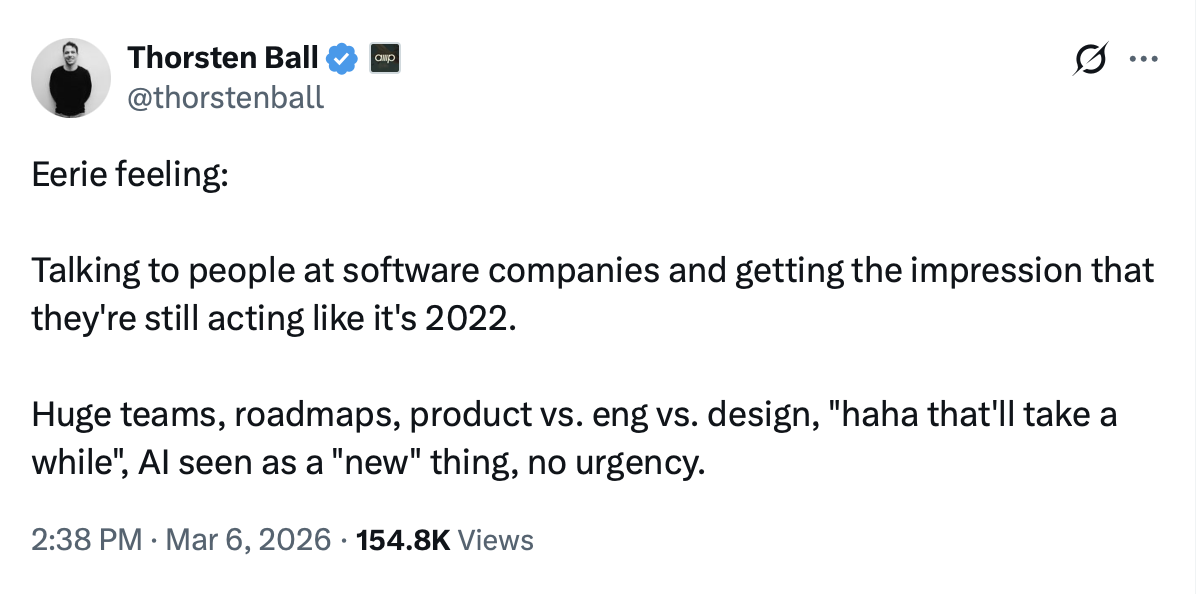
The frontier doesn’t wait for you to get comfortable with the diagnosis.
I don’t know what kind of company you’re in, and I don’t know whether the patterns above describe your Tuesday or someone else’s. I hope this helps you name what you’re seeing and make a judgment call about what kind of company to spend your time in. That’s a decision worth getting right.
PS: this applies to software and software-adjacent industries. It may not apply to manufacturing, repairs, maintenance, healthcare, or other sectors where the physics of the work are different. If you’re in those industries, you’ll know whether this resonates.
