Every Company is a Startup Now
Large companies spent years rewarding the representation of work over the work itself. In the AI era, that has led to a crisis.
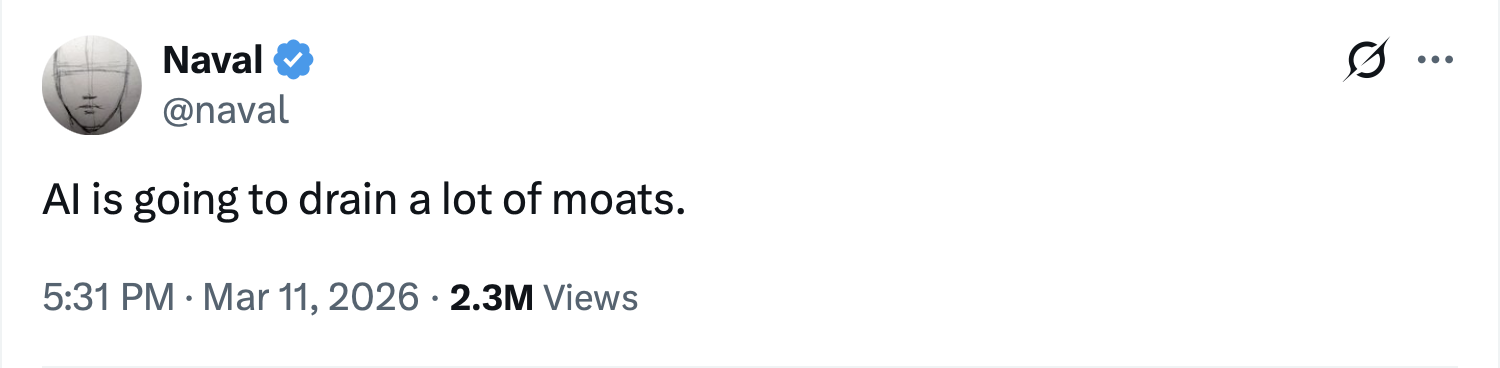
AI has compressed the cost of building to the point where a five-person team can credibly attack a market you’ve owned for a decade. They don’t need your distribution yet. They don’t need your brand yet. They need a better product, and they’re building it with a fraction of the people in a fraction of the time. The structural protection your company was relying on (we’re established, they’re scrappy upstarts) is gone. The moat was real. But these moats are draining really fast now. This isn’t a cyclical downturn. The rules that kept large companies safe for decades no longer apply.
A caveat: what follows applies to software and software-adjacent industries. It may not apply to manufacturing, repairs, maintenance, healthcare, or other sectors where the physics of the work are different. If you’re in those industries, you’ll know whether this resonates.
Every startup begins default dead: no new customers, no growth, no next round. Survival gets earned one shipped thing at a time. Large companies have not had to fight for survival in a long while. But that has changed now.
Scaffolding became the building
At some point your company was small. Everyone knew what shipped last week, who built it, what didn’t work. Decisions moved fast because they had to.
Then it grew. More people, more distance between the people making decisions and the people doing the work. Nobody could see the whole picture anymore. So you started building structures to restore visibility: written briefs, roadmaps, quarterly priorities, planning cycles. Ways of making work legible across a surface too large to read.
The structures helped with scale at first. But over time, upholding the structure became a full-time job eating into people’s time.
The people who were getting promoted weren’t always the better builders. They were the better narrators. The person who could write a sharp brief, translate a messy quarter into a clean story, walk into a room and make leadership feel like they had a plan. That person moved up. The builder, the one who moved fast, said little, and shipped, became harder to evaluate. Real output with low legibility. In a large org, legibility is the job.
So your org started optimizing for what it could measure. Over years, it converted the builders. Some learned the meta game and leaned into it. Some drifted to the margins. Some left. The ones who rose mastered the representation of work over the work itself. Written briefs replaced prototypes. Review meetings replaced shipping. Quarterly ceremonies replaced judgment.
The org didn’t forget how to build. It spent a decade rewarding people for everything except building, and they acted as per the incentives established.
If you’ve been in a large company long enough, you’ve watched this happen. You might have participated in it. Not because you’re cynical. Because the system was rewarding it and you acted as per the incentives established.
That’s the trap. And AI made it a crisis.
We’re all in the mosh pit now
The latest YC batch isn’t in a different league. They’re in your market, targeting your customers, shipping faster than your team can complete a planning cycle.
Your revenue needs defending now with the same urgency a first-year startup brings to earning it. The foundation you built is a position, and positions get contested. Market share that took years to build can erode in months. Customers who stayed because switching was painful are finding better options that are also easier to adopt. The AI-native alternative is often simpler, faster, cheaper. And it will keep getting better every quarter while your roadmap sits in review.
When did you last ask yourself, honestly, not in a town hall, not in a quarterly review, whether your company could survive if it had to earn its market position from scratch today?
For a startup, the answer structure is clear. Small team, tight loop, existential pressure, total focus.
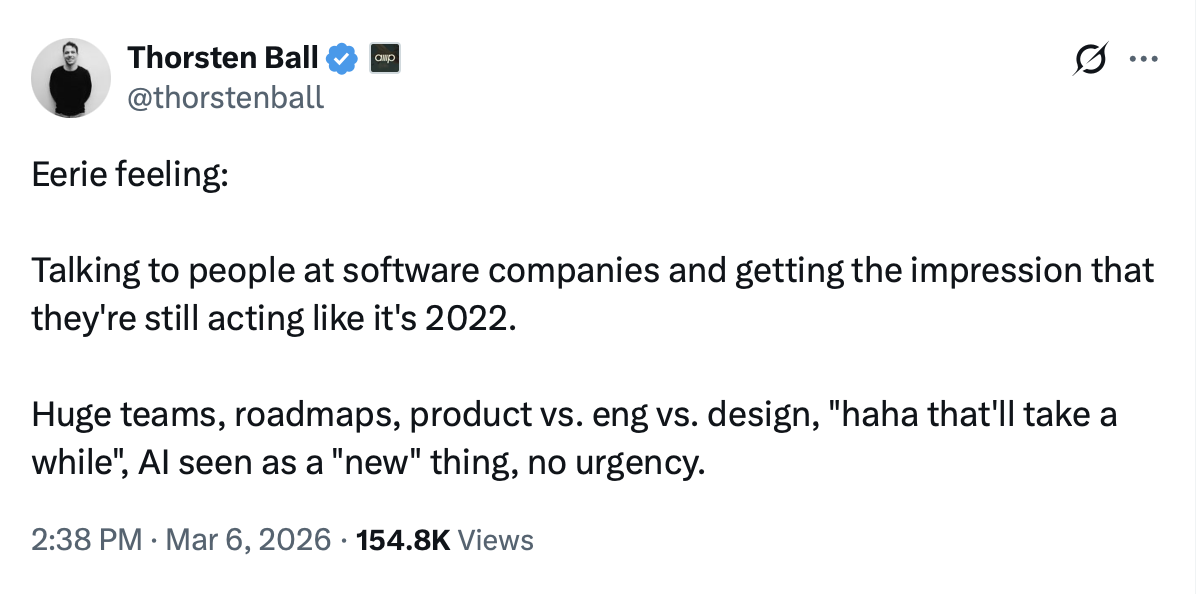
For your company, that same question is landing on an org built for a different era. Thousands of people. Layered approvals. Diffuse ownership. A culture that spent years advancing the people best at representing work rather than doing it. The question is the same. The machinery to answer it is not.
The people problem
The ability to figure things out under pressure is rare. It doesn’t accumulate with seniority. The people who have it bias toward action, decide with incomplete information, and have no patience for managing upward. They want to build something and watch it land.
Your org has been selecting against them for years. Not through any deliberate decision, but structurally, through what it was choosing to reward. The people who rise learn to navigate: build consensus, manage stakeholders, convert ambition into something presentable at the end of a quarter. Legitimate skills. When the crisis hits and your company lands in figure-it-out mode, you look around and find those people are gone. Pushed out, worn down, or never hired.
Bringing a startup operator in won’t fix this either. The culture, the incentives, the immune system, it all mobilizes against them. What reads as decisive in a survival-mode company reads as abrasive in an org that spent years rewarding process adherence. The body rejects the organ. Then, having rejected it, your leadership concludes the problem was the person.
It wasn’t the person. It was a system that had no room left for the kind of person it now desperately needs.
The AI wave isn’t caring about your org chart. It isn’t slowing down while you restructure. The window to get the right people doing the right work is open right now and it won’t stay that way.
Meeting the market
Every time a startup ships, it is running an experiment. Something goes out, customers respond, the team learns something real: what language customers use, which problems feel urgent, where they abandon the product, what they tell colleagues. Knowledge earned through contact with reality, accumulated across dozens of cycles.
At a large company, when someone has a good idea, it goes into a brief. The brief gets reviewed. The review shapes a proposal. The proposal enters the planning cycle and produces a roadmap entry. The roadmap entry gets prioritized, then deprioritized, then re-prioritized after a leadership change. A team gets identified. The team is already at capacity so bandwidth gets negotiated. A quarter gets allocated. Dependencies get mapped. Approvals get sought. Stakeholders get aligned. Many weeks later, someone finally writes the first line of code.
By then the startup has shipped forty things. It has talked to hundreds of customers. It has killed three ideas that didn’t work and doubled down on two that did. It has an entirely different understanding of the problem than it had when it started, operating on real signal earned through real contact with the market.
Your company is operating on a hypothesis that is now two quarters old.
The speed gap matters. What it produces matters more. You are working from older, thinner, less accurate information about a market that is transforming faster than at any point in the last two decades. Every decision flows downstream from that deficit. And you can’t feel it from inside. The roadmap looks full. The calendar looks busy. The work feels real. You are drifting from the market with every sprint that doesn’t put something real in front of customers.
How many quarters has it been since something your team shipped genuinely surprised a customer? Not impressed them. Surprised them. If you’re struggling to answer, you have your answer.
Cadence leads to confidence
Your customers are reading your shipping cadence whether you realize it or not.
When you ship consistently, they feel it. It tells them you’re in control of your direction, listening, not done. Press releases declare intent. Shipping demonstrates it. Customers have always known the difference.
When you go quiet, when you ship a major release and then disappear for eighteen months, customers feel that too. The distance between when you think and when you act is growing very large. They won’t articulate this. You’ll see it in behavior. They’ll take a meeting with a competitor they’d have ignored a year ago. They’ll respond to a cold email from a startup they’ve never heard of. You won’t lose them with a bad product. You’ll lose them with silence.
Survival demands speed and fitness. Fitness here is the ability to show up to the market with real launches, take feedback, and iterate. The longer ideas were staying in planning instead of in front of customers, the less accurate your understanding of the market was getting. That drift compounds quietly, invisibly, until the gap is too wide to close fast.
Your customers are living through one of the most disorienting technological shifts of their careers. They are hearing about AI a hundred times a day. In meetings, in the news, from competitors, from their boards. Very few of them will go figure out what it means, how to use it, or how to apply it to their business on their own. That’s your job. The maker’s job. To show up with a point of view. To demonstrate what’s possible. To lead them through the change rather than wait for them to find their own way.
You can’t do that from behind a desk full of reviews and approvals. You have to front up. Get into the weeds with your customers. Figure it out together, in public, through the product. That’s what builds real trust. That cadence tells the market you’re there for them.
Cadence is the proof of execution, full stop. If you can’t ship at a meaningful rhythm, you can’t credibly tell the market you’re adapting. The market won’t wait for your internal transformation to finish before drawing its conclusions.
The point of no return
There’s a threshold. Companies were crossing it before they even realized it existed.
Beyond it, the accumulated weight of systems, inertia, and organizational habit makes course correction nearly impossible through normal means. New leadership can articulate a vision. A reorg can flatten the hierarchy. A transformation initiative can generate genuine energy. None of it reaches the root.
The root is ten years of incentives that produced a specific kind of person, in large numbers, at every level. Skilled, credentialed, well-compensated, and pointed the wrong way. People who believed the work they were doing was the right work because every signal they received told them it was. People who are now being asked to navigate a technological shift that rewards the instincts the organization spent years training out of them.
Fixing that requires rebuilding how people get hired, how they get promoted, and what the org considers real work. Your leadership team would have to look honestly at what they’ve been selecting for and conclude it was the wrong things. That conclusion is available to anyone willing to reach it. Few do. Because the people who’d have to reach it rose through the same system, were rewarded by it, and dismantling it means questioning everything that got them to where they are.
This is where large companies stall. The diagnosis is available. The will to act on it completely isn’t. And meanwhile, the market keeps moving.
Some companies will navigate this. Many won’t. You probably already sense which category yours is in.
The ones that make it are putting builders back in positions where building is what gets rewarded. They are compressing idea-to-ship until it’s measured in weeks. They treat market feedback as the primary input to every decision rather than something to be interpreted, filtered, and presented upward. They understand that cadence is how you fix everything else, not something you achieve after you fix everything else. And they are doing all of this with the urgency of a company that knows the window is open right now and won’t stay that way.
The ones that won’t are easy to spot. They are producing lengthy documents about their commitment to moving faster. Running innovation workshops. Scheduling the offsite to discuss why they need to feel more like a startup.
Every company’s survival is under scrutiny. But only startups act like they know it.